

Interview: Strengthening the Foundation for Tokyo-Paris Financial Cooperation
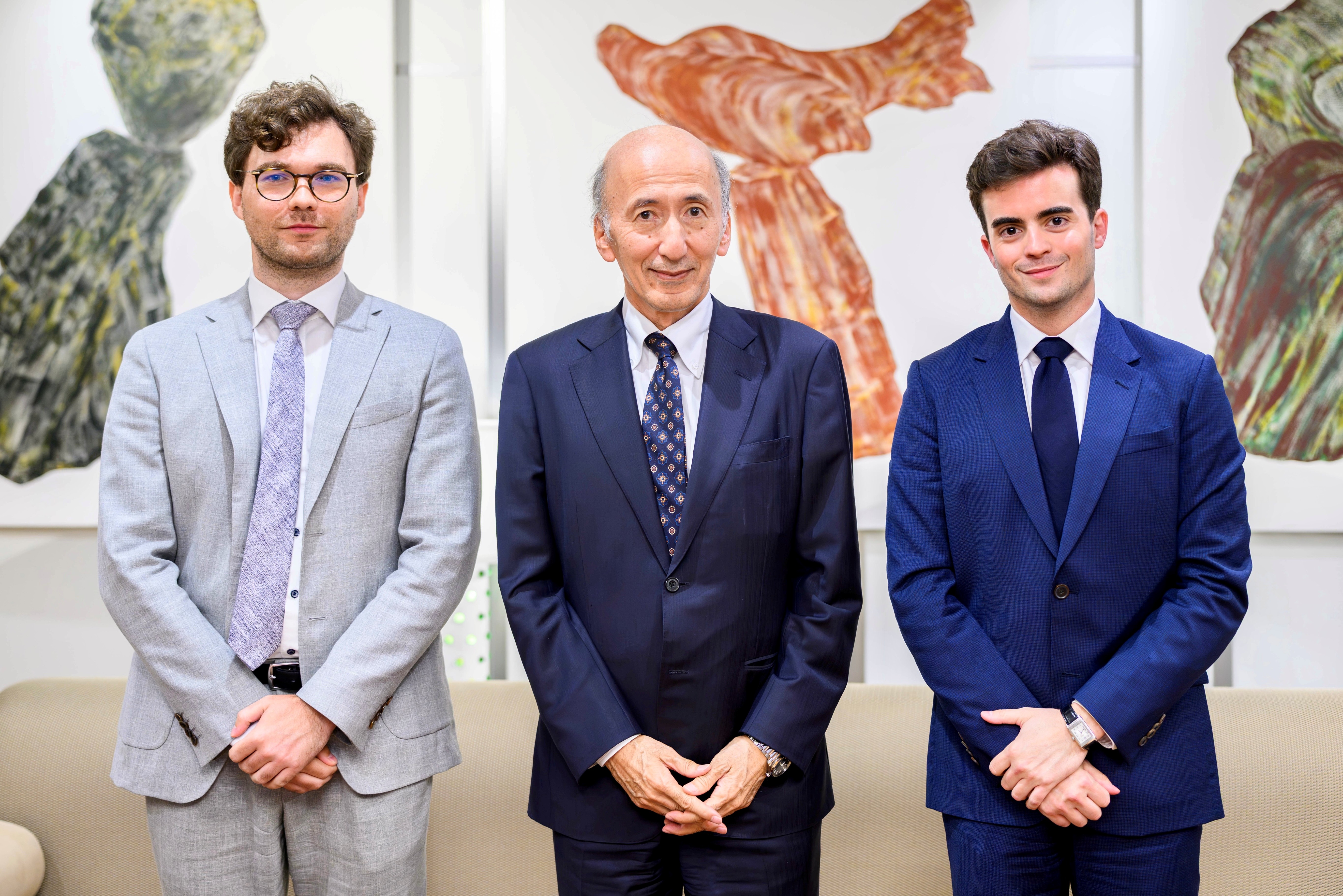
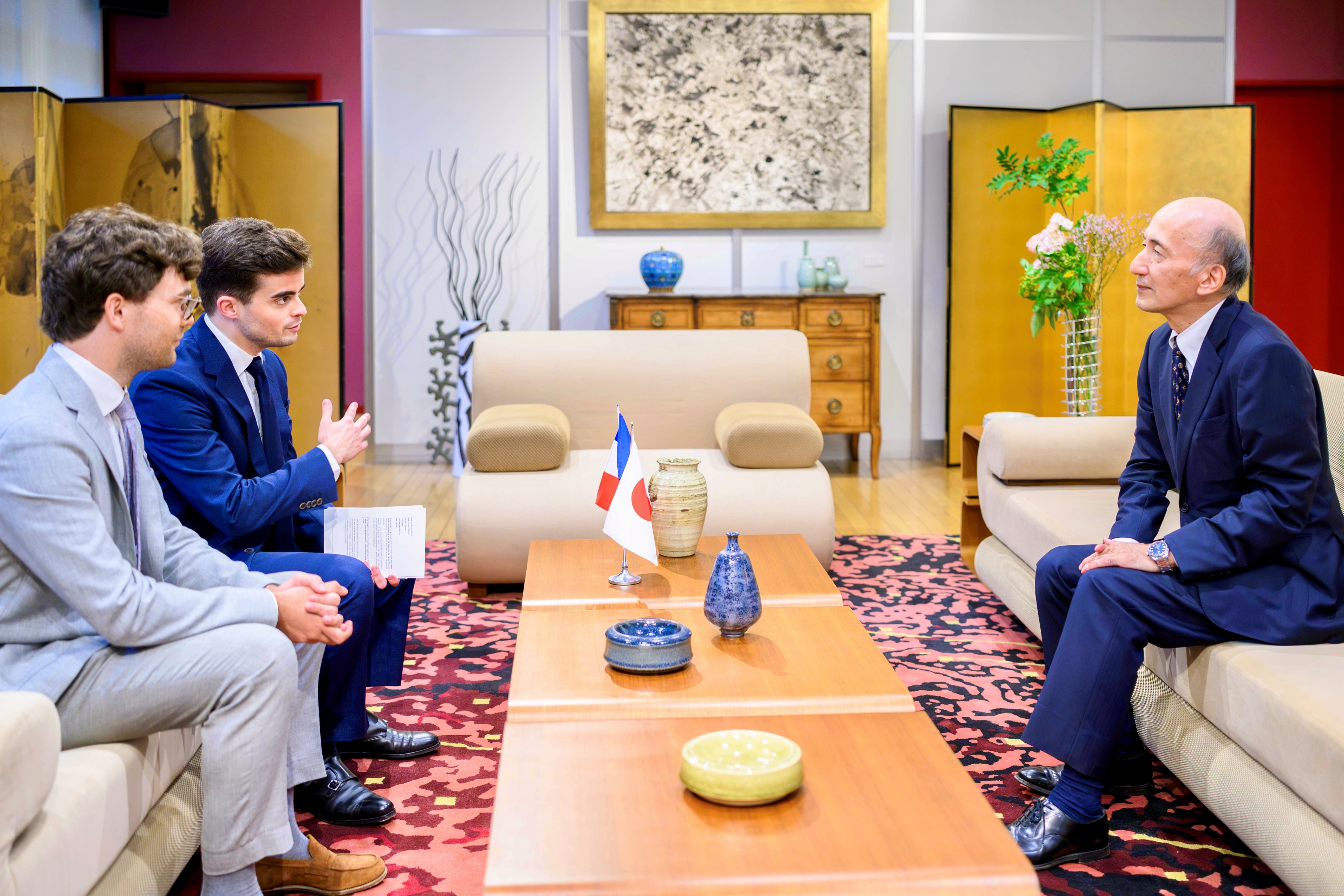
FinCity.Tokyo Chairman Hiroshi Nakaso met with Banque de France’s representative in Japan, Arthur Sogno Pèes, and his successor Quentin Dufresne to discuss the growing financial cooperation between Paris and Tokyo, which gained renewed momentum with Banque de France becoming a FinCity.Tokyo member in June 2026.
Banque de France is now a member of FinCity.Tokyo. What is the significance of this?
Chairman
We are delighted to welcome the Banque de France as a Special Member. This is not only a prestigious milestone for our membership expansion, but also a timely and strategic step in deepening our ties with Paris. While Paris Europlace has been our valued partner under an MoU signed in 2019, the COVID-19 pandemic temporarily disrupted our collaboration. Welcoming the Banque de France into our community injects vital energy into Tokyo’s ecosystem, and we look forward to building on this strong foundation of mutual trust and cooperation.
Based on my experience as a central banker, the networks of central banks play a fundamental role in maintaining global financial stability and preserving price stability. In carrying out their core mandates, they develop solidarity among themselves, fostering trust across international ecosystems. As such, the central bankers’ network and their information assets are invaluable to FinCity.Tokyo’s promotional and strategic activities to uplift Tokyo’s financial center.
Mr. Sogno Pèes
The Banque de France joined FinCity.Tokyo as a Special Member because structured cooperation between trusted financial centers has become a strategic necessity. We align on financial stability, safe and efficient payments, responsible innovation, sustainable finance, and the mobilization of capital in support of the real economy. FinCity.Tokyo’s ambition to strengthen the investment chain and harness finance to address economic and social challenges is therefore complementary to the Banque de France’s own missions.
We see this membership as much more than a symbolic milestone: it reflects our shared ambition to strengthen dialogue and cooperation between the French, European and Japanese financial communities. It also builds on a longstanding institutional relationship with Japan. The Banque de France has maintained close relations with the Bank of Japan and the Japanese authorities for decades, while its permanent representation at the Embassy of France in Tokyo dates back to 1998.
How can Tokyo and Paris best cooperate as financial centers?
Chairman
The world’s geopolitical, economic, and financial landscape is undergoing profound structural shifts, so reinforcing the ties between Japan and France—two key economies that share fundamental values—is more essential than ever. We would like to collaborate in channeling capital into sustainable and transition finance and into the 17 strategic fields designated under Japan’s Growth Strategy such as AI, robotics, aerospace, fusion energy, and quantum computing—the very sectors that will drive global competitiveness over the coming decades.
Especially with regard to sustainable finance, Japan has pioneered a robust transition framework to enable hard-to-abate sectors to move realistically toward net-zero targets. Japan’s domestic private-sector transition finance market has also grown, reaching a cumulative total of approximately JPY 2.9 trillion as of the end of 2025 (approx. USD 18.1 billion*). Sharing our operational experience in transition finance can offer valuable insights for European capital markets as they scale up transition and decarbonization instruments.
Mr. Sogno Pèes
Paris offers a dense European ecosystem of financial institutions with direct access to the EU single market. Tokyo offers deep savings, major long-term investors, globally active financial groups, and a powerful industrial and technological base.
Cooperation should concentrate on four areas: sustainable and transition finance as Nakaso-san mentioned; digital finance, tokenization and cross-border payments; asset management and growth capital; and infrastructure finance. The Memorandum of Understanding signed by FinCity.Tokyo and Paris Europlace in 2019 already provides the institutional framework.
What are some of the latest developments in the Paris ecosystem that should be on Tokyo’s radar, and vice versa?
Mr. Sogno Pèes
Three developments merit particular attention.
First, the European Union’s Savings and Investments Union is moving from strategy to implementation. Its purpose is to channel more European savings towards productive investment, innovation and strategic priorities. This should create further opportunities for Japanese banks, insurers and asset managers across European capital markets, private assets and infrastructure.
Second, Paris is accelerating its work on tokenized finance. Paris Europlace published a dedicated digital finance strategy in March 2026 and further proposals on tokenization in June.
Third, sustainable finance is entering a more operational phase, increasingly focused on financing the transition, adaptation to climate change and measurable outcomes in the real economy.
Chairman
To enhance Tokyo’s financial ecosystem, one of our key flagship initiatives is the Emerging Managers Program (EMP). Designed to identify and showcase high-performing, independent asset managers with short but promising track records, the EMP connects them directly with institutional asset owners. Notably, this program was originally inspired by Paris’s Emergence initiative. Over the past few years, we have built a vibrant network of Japanese emerging managers, fostering dynamism in asset management.
A complementary initiative is our foreign financial institution attraction project, or Attraction U, under which we offer tailored support to global asset managers and fintechs expanding into Tokyo.
In November this year, Tokyo will join Paris InfraWeek for the first time. What are your expectations for this?
Mr. Sogno Pèes
We warmly welcome FinCity.Tokyo’s first participation in Paris InfraWeek. Its tenth edition, which will take place from 2 to 6 November 2026, will focus on energy, digital and security infrastructure. These are critically important sectors that lie at the intersection of competitiveness, resilience and sovereignty, and where Japanese expertise will be very valuable.
The objective should go beyond visibility. Tokyo’s participation should connect Japanese institutional investors, banks, trading houses and public financial institutions with European project sponsors, infrastructure funds, lenders and public authorities. Success should be measured by the concrete follow-up: investable project pipelines, co-investment opportunities, and shared approaches to risk allocation, transition criteria and resilience. Paris InfraWeek could become a recurring anchor for FinCity.Tokyo’s engagement in Paris, complemented by stronger participation from Paris-based institutions in Tokyo.
Chairman
Participating in Paris InfraWeek for the first time is a very important step for us in establishing FinCity.Tokyo’s permanent footprint in Paris. Building on our successful engagements at key global events—such as establishing Tokyo’s presence during London Climate Action Week—we aim to leverage Paris InfraWeek to act as a bridge and catalyst for Japanese and European financial institutions.
Infrastructure is rapidly evolving from a traditional real-asset class into a strategic driver of economic resilience and national competitiveness. In Japan, replacing aging infrastructure with resilient, eco-friendly, and smart solutions is a pressing priority. In Europe infrastructure sits directly at the intersection of climate transition, energy sovereignty, and digital security.
For these reasons, there is now a great opportunity for Tokyo to become an active co-creator in infrastructure finance in Europe—connecting Japanese institutional investors, banks, and trading houses with European project sponsors to foster concrete partnerships.
Related
関連記事