

Interview:“360 Degrees Beyond the Peak” — Tokyo’s Potential in an Age of Population Decline
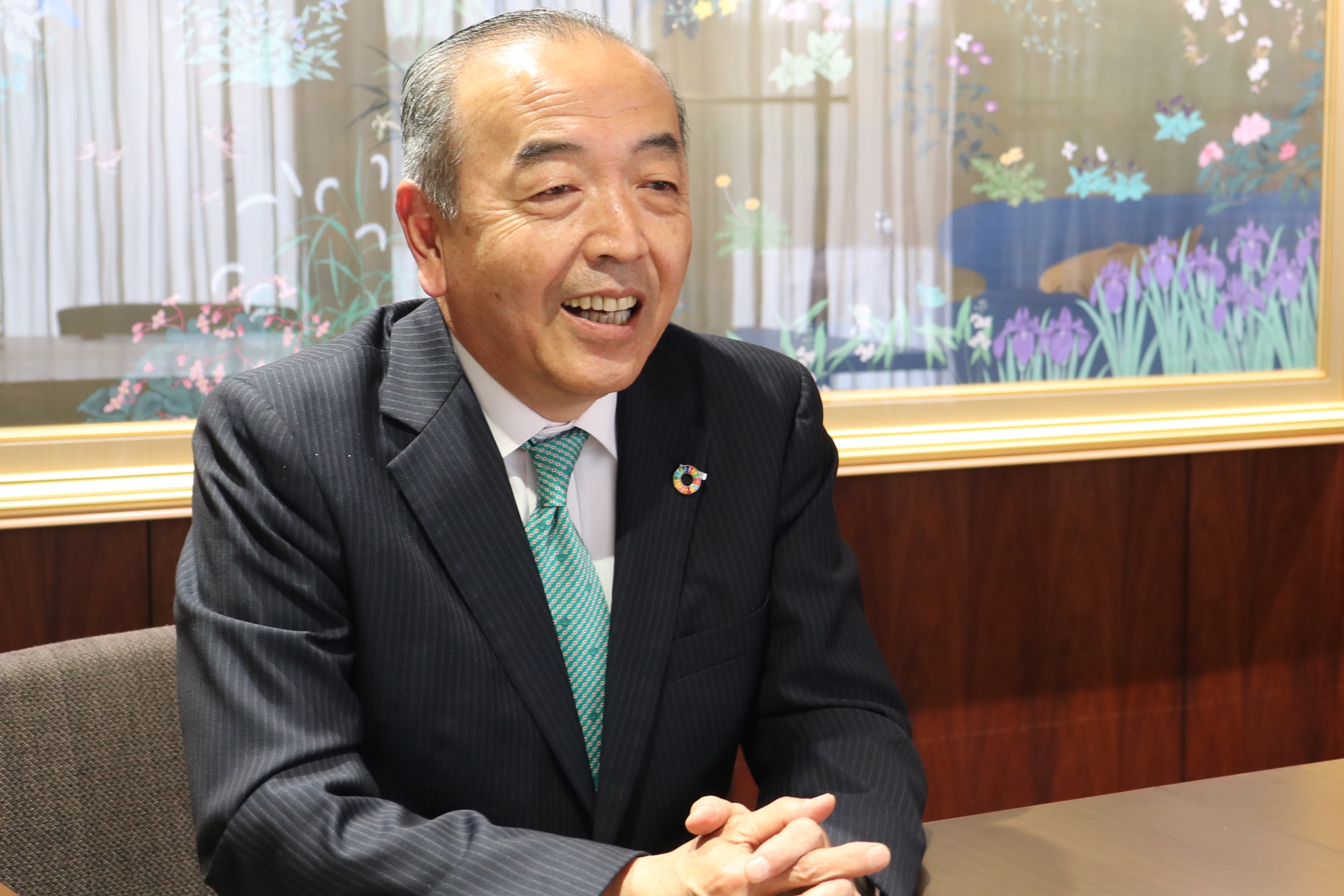
Ichiro Takahashi, President of Seibu Shinkin Bank, shares his insights on the role of shinkin banks — member-owned cooperative financial institutions — and the vision Tokyo as a financial hub should pursue in an era of population decline.
Please tell us about the activities and role of shinkin banks. It is said that the roots of shinkin banks lie in industrial-era Britain. How did they develop into their present form?
Shinkin banks are cooperatives, and in that respect their organizational form is fundamentally different from that of banks, which are joint-stock companies that pursue profit. In joint-stock companies, economic rationality is emphasized, whereas shinkin banks are cooperative organizations established for the mutual assistance of local users and members.
If we trace the roots of the cooperative movement, they do indeed lead back to the Industrial Revolution in Britain, as you noted. At that time, movements arose independently and at roughly the same time in different countries—for example, the Rochdale Principles in Britain and Raiffeisen in Germany. In an age before advanced communications, similar developments appear to have emerged in different places without close coordination. As capitalism, which favored large capital, spread, workers and small-scale business operators sought not to be left behind. Under the ideal of mutual assistance, they came together voluntarily in their communities and joined forces. That was the origin of cooperatives.
A similar development took place in Japan around the time of the Meiji Restoration. The idea of cooperation was introduced by pioneers such as Ninomiya Sontoku. Our own roots lie in industrial cooperatives, in which local merchants shared tools and helped one another with labor. They did not come together for profit; they cooperated without compensation and sought to improve their communities. Because that spirit of cooperation is the very origin of the movement, our bank continues to uphold it, and for that reason we do not charge our customers fees for business matching.
You have declared that you will stop management focused on chasing figures such as deposit balances and lending volume. What goals and indicators do you use for your business instead?
The indicator I value most is what percentage of our client companies are operating profitably. At a time when 65 percent of small and medium-sized enterprises are said to be loss-making, 68.8 percent of our customers are maintaining profitable operations. I am convinced that this figure is what truly demonstrates the results of our efforts. Three years ago, we introduced a system under which each of our 350 field representatives is evaluated based on personal performance indicators such as how many of the companies they are responsible for became profitable and how many increased their sales. I believe the decisive difference between us and ordinary financial institutions is that employees are evaluated for working for the customer, and that the axis of measurement is placed on the customer’s side. Because our customers are profitable and repay on time, our level of non-performing loans is among the lowest in Japan, and we have been able to achieve record-high profits. I believe that improving the management condition of our customers is the true role of a shinkin bank as a cooperative.
Please tell us about the fields and initiatives you are especially focused on right now.
There are three pillars. The first is the business support program to help SMEs return to profitability, which I mentioned earlier. About 30 years ago, we reconsidered the conventional financial model of collecting deposits and making loans and began an initiative in which our staff themselves go out and sell our customers’ products and services. Since then, we have developed many business-matching initiatives and industry-academia collaboration projects with 27 universities. When it comes to solving various management issues or supporting applications for subsidies, we dispatch specialists for the benefit of busy SME owners, and we bear those costs ourselves. From time to time, people from outside tell us that the SME, as the beneficiary, should bear the cost. Our objective is to improve our customers’ business performance, and if that in turn leads to a reduction in credit risk, then Seibu Shinkin Bank is the real beneficiary of those support efforts, so we should be the one to bear the cost and labor, not the customer.
The second pillar is venture investment. Twenty-five years ago, we established what was, for a shinkin bank, a pioneering venture capital firm. We have invested in 152 companies to date, and 20 of them have gone public. As a result of focusing our investments on business models that solve regional issues, we have been able to generate profits.
The third pillar is support for NPOs and social businesses. As the population declines, tax revenues shrink, and public services recede, there arises a need for organizations that can fill the gap in welfare and regional revitalization. Twenty-three years ago, our bank began supporting NPOs through loans and grants, at a very early stage by Japanese financial-sector standards. Today, I believe we may well be the private financial institution with the largest number of transactions with NPOs. The way NPOs gather and collaborate without compensation for the sake of the community has something in common with the spirit of the cooperative movement.
How do you view the future of Tokyo as a financial city?
In the 21st century, amid a declining-population society, I believe the era has ended in which Tokyo could pursue its appeal through a sense of continuing to grow by absorbing the regions as it has done until now. I see great potential in a Tokyo that cherishes what it has originally possessed while also contributing to the revitalization of the regions as a hub for them. This is something I often speak about in my lectures: by accepting the reality of a shrinking-population society and redesigning a new model that is not based on taking from one another, an entirely different landscape comes into view.
I often say, “A mountain looks conical when seen from above.” In a population-growth society, the contest was about who could reach the summit first. Since there was only one summit, the only option was to climb as fast as possible, even if that meant pushing others aside, in order to grow. But now that we are on the downward slope of population decline, there are infinitely many paths down, and one may head in any of 360 degrees. I believe the 21st century, which is shifting from an era of time-based competition to an era of diversity, will be the age of small and medium-sized enterprises—businesses that produce small quantities of high-value-added goods, deliver them to core customers, and can make agile, flexible shifts in direction. Rather than the kind of competition seen in the 20th century, in which one defeats the other side, I am convinced that if SMEs, government, business organizations, NPOs, younger generations working on social impact, and financial institutions all come together with cooperation and collaboration as their guiding principles and work in partnership to create new value, a powerful cycle not dependent on population growth will emerge. Tokyo is home to a great concentration of SMEs with precisely these strengths, and I believe that is a major advantage for Tokyo and that Tokyo’s potential can expand greatly.
Related
関連記事