

Connecting with the World Through Resilience Bonds — Tokyo Metropolitan Government joins FinCity.Tokyo event, shares lessons from promoting Tokyo’s initiatives in London
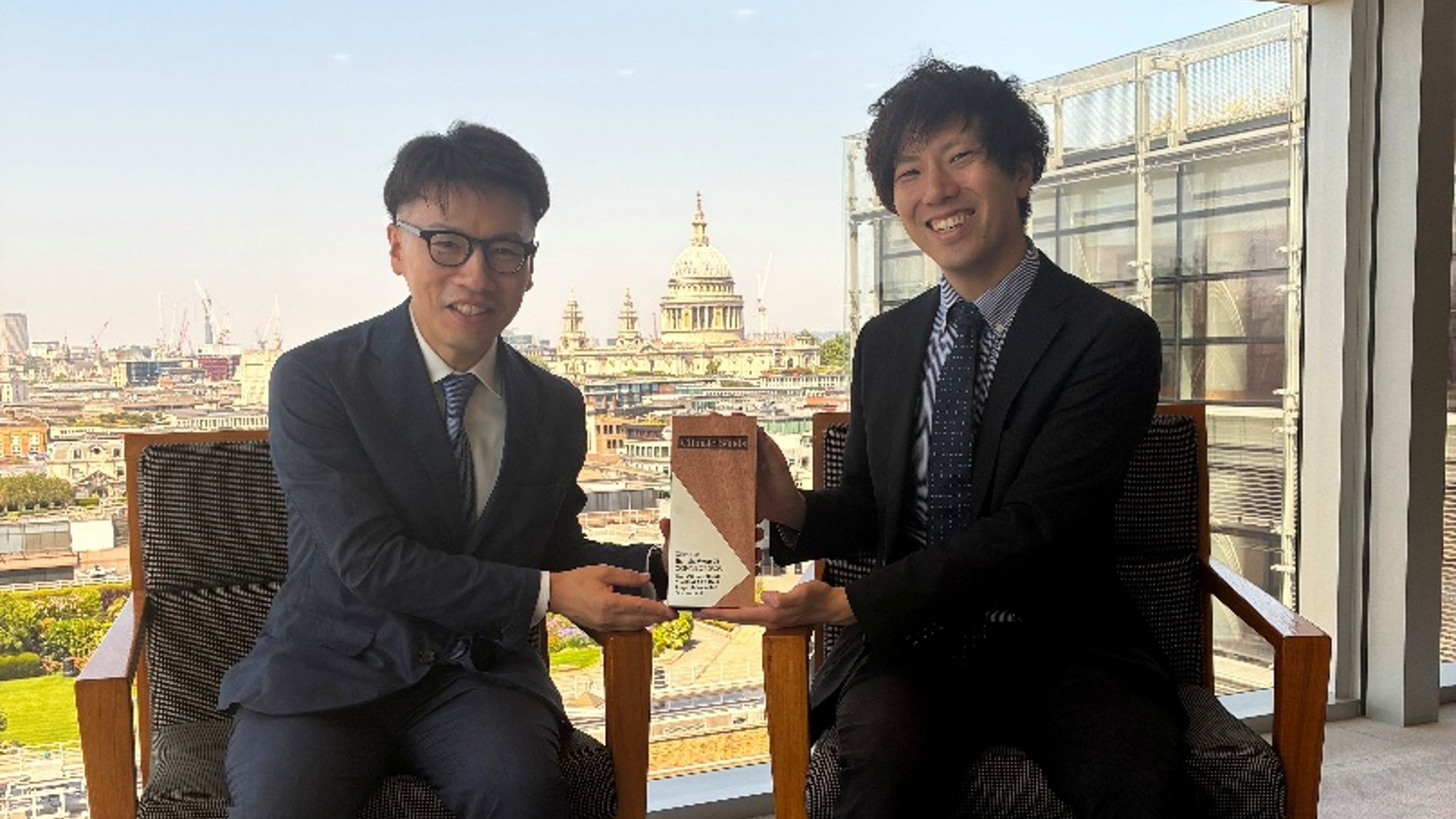
(Mr. Sasagawa and Mr. Shimizu holding the 2026 Climate Bonds Award, presented by the Climate Bonds Initiative to the Tokyo Metropolitan Government for the TOKYO Resilience Bond during the London Climate Action Week in June this year.)
The UK-Japan Transition Finance Forum 2026, one of the flagship events hosted in London by FinCity.Tokyo during the London Climate Action Week(LCAW)as a follow-up to last year’s success, explored the growing collaboration between Japan and the UK in raising finance for the green transition. We interviewed Mr. Sadaaki Shimizu and Mr. Takehiro Sasagawa from the Tokyo Metropolitan Government about the TOKYO Resilience Bond and TMG’s efforts in sustainable finance, which were central to the events, along with their thoughts on why the UK-Japan collaboration matters at this time.
Interviewees
- Mr. Sadaaki Shimizu, Deputy Director, Bond Section, Budget Division, , Bureau of Finance, Tokyo Metropolitan Government
- Mr. Takehiro Sasagawa, Director for Comprehensive Global Financial City Strategy, Bureau of Industrial and Labor Affairs, Tokyo Metropolitan Government
Where does Tokyo’s strength lie when it comes to securing funding for net zero?
Sasagawa: Tokyo’s greatest strength lies in its enormous GDP of 120 trillion yen, backed by its large population, and its 2,200 trillion yen in household financial assets. This level of GDP is comparable to the national budget of an entire country, and together with its household financial assets, it serves as a major driving force for promoting sustainable finance.
Shimizu: A strong and sustainable fiscal base is also one of Tokyo’s major strengths. Tokyo maintains a very sound fiscal position because it has a high ratio of independent revenue sources and a low ratio of mandatory expenditures. As a result, its standalone credit rating is AA+, which is above Japan’s sovereign rating of A+. The market also highly values Tokyo’s track record of issuing benchmark bonds in international markets for more than 15 years, as well as its consistently pioneering efforts in the bond field, from green bonds to last year’s resilience bond.
Why is UK-Japan cooperation important in the field of sustainable finance?
Sasagawa: London is a global financial center and has a strong track record of leading discussions on sustainable finance. Tokyo has shared knowledge through a memorandum of understanding with the City of London on exchange and cooperation. While Japan is focused on Asia, London leads globally, including in Africa. A partnership between the two is extremely important in addressing global decarbonization and sustainable finance challenges.
Shimizu: From the perspective of the bond market, London is home to many investors with a strong interest in sustainability, especially resilience. Tokyo’s foreign bonds are also listed on the London Stock Exchange, so our relationship with London is indispensable for connecting with investors around the world and communicating information.
What led you to speak at the London events?
Shimizu: I had originally planned to visit London to attend an awards ceremony hosted by the Climate Bonds Initiative, and then FinCity.Tokyo invited me to speak. I saw it as a valuable opportunity to promote Tokyo’s bonds, especially the TOKYO Resilience Bond, to the world, so I participated.
Sasagawa: I am in charge of promoting sustainable finance at the Tokyo Metropolitan Government, and FinCity.Tokyo asked me to help communicate Tokyo’s efforts in London. I also thought it would be an excellent opportunity to hear local discussions directly and gather information that could be applied to Tokyo’s future policy, so I joined the forum.
What specifically did you talk about at the forum?
Sasagawa: My main message was the importance of channeling Tokyo’s vast financial assets into transition finance in Asia. At the same time, I emphasized that Tokyo is an attractive investment destination. Concerns are often raised about language barriers, so to address those concerns I highlighted the support systems Tokyo has put in place, including English-language business support through the Tokyo One-Stop Business Establishment Center and Business Development Center Tokyo, improvements to the living environment, and subsidy programs. I stressed that Tokyo is creating an environment where not only overseas companies but also their families can smoothly relocate and settle.
Shimizu: I explained the overall framework of Tokyo metropolitan bonds. In particular, I focused on the concept and use of proceeds of the TOKYO resilience bond, which is drawing especially strong investor interest.
What insights did you gain from this experience, and what stood out most?
Sasagawa: I had understood resilience in Europe purely as a concept in the context of climate change. But when I actually came here, I found that people naturally discussed it from the perspective of defense and security as well. Realizing that there are still entire worlds I had not known about was a major insight for me.
Shimizu: I once again felt that advanced initiatives such as Japan’s Climate Transition Bonds (GX bonds) and the TOKYO Resilience Bond are attracting significant global attention. To move beyond the traditional “green” framework and steadily advance decarbonization while responding to actual disasters and climate risks, funding for the resilience field is becoming increasingly important. Through this forum, I strongly recognized that global interest in this area is rising.
What kind of reaction did you receive from the UK side?
Sasagawa: We received many positive comments such as about how interesting it was. There were also many fundamental questions, such as what it really takes to advance transition, and I felt that experts around the world share the same challenges we are facing. We were able to have discussions that went well beyond the presentation itself, and I felt a strong sense of momentum.
Shimizu: We heard from many stakeholders, including investors, that they wanted to learn more about our resilience bond, and we also received concrete advice on how to further enhance our investor relations. We also attracted media attention and had opportunities to give interviews. Overall, I felt a very high level of expectation and interest in the TOKYO Resilience Bond.
Going forward, how should Tokyo work with the world’s financial hubs to advance net-zero finance?
Sasagawa: There are two main points. First, we must keep taking action and keep communicating. Japanese government bodies tend to act cautiously and communicate only after all coordination is complete, but the financial world works the other way around. First you communicate, raise awareness, and then make small adjustments if needed. Taking action first and sharing it is crucial. Second, Tokyo must not lose what makes it Tokyo. Safety is important, of course, but so are Japan’s unique strengths such as politeness, diligence, and trust. I believe Tokyo should cooperate with other cities while maintaining those qualities.
Shimizu: The most important thing is to communicate Tokyo’s initiatives effectively to the world. Events like this, hosted by FinCity.Tokyo and the Climate Bonds Initiative, are extremely valuable opportunities to directly present Tokyo’s efforts to international investors and stakeholders and deepen their understanding through dialogue. From the perspective of a bond issuer, our primary goal is fundraising, but that is not all. By issuing resilience bonds, we also aim to communicate Tokyo’s efforts to strengthen resilience to the world and promote investment in the resilience field globally. We want more people to learn about these efforts, realize that they too want to participate, and build that awareness into collaboration. That will deepen understanding of Tokyo’s initiatives and expand resilience investment, which in turn will attract more investors and make Tokyo’s fundraising easier. We want to create that kind of virtuous cycle.
Related
関連記事