Interview: Smoothing Out Japan’s Evolving Financial Securities for the January 2026 Newsletter
29 JANUARY 2026Interviews
Interview: Smoothing Out Japan’s Evolving Financial Securities for the January 2026 Newsletter
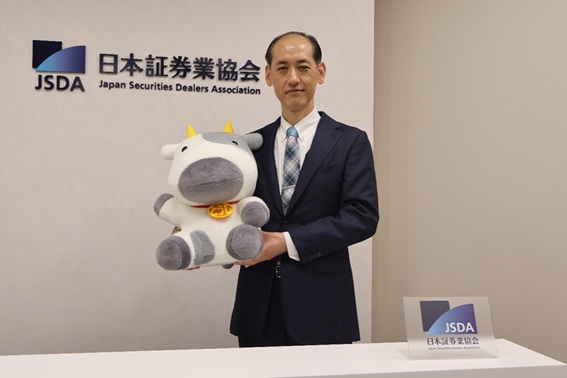
Kenichi Morimoto, Executive Director (Chief Officer for Planning) at the Japan Securities Dealers Association, spoke with us about sustainable finance, and Japan’s transformation into an “Asset Management Nation.”
Could you tell us what kind of organization the Japan Securities Dealers Association is?
The Association was established in July 1973 through the integration of the securities dealers’ associations and their federation that had previously existed in each region across the country. Since then, after going through several changes, more than 50 years have passed since its founding. The Association aims for the fair and smooth operation of the financial and capital markets, the sound development of the financial instruments business, and the protection of investors. It is the only organization accredited by the Prime Minister under the Financial Instruments and Exchange Act.
Based on these objectives and its position, the Association broadly undertakes activities including self-regulatory operations, initiatives as an industry group, and activities such as information gathering and overseas PR and information dissemination through participation in international conferences and exchanges with related foreign organizations. As of the end of December 2025, the Association’s membership includes 261 regular members (Type I Financial Instruments Business Operators such as securities companies), 200 special members (registered financial institutions such as banks), and 11 specified business members (companies specializing in equity crowdfunding, etc.).
The Association is engaged in a variety of activities.
As explained earlier, the Association undertakes a wide range of work, including matters of self-regulation, industry affairs, and international relations, and I will briefly introduce the whole picture.
First, in terms of self-regulatory operations, we establish and operate self-regulatory rules regarding the conduct and internal controls of members and their officers and employees, as well as financial transactions, and conduct audits and monitoring of compliance, impose sanctions for violations, and undertake initiatives to prevent recurrences. We also work on the arrangement of systems related to unlisted stocks, which includes supporting startup development, the establishment of markets and publication of statistics for off-exchange trading in listed shares such as PTS, bonds, and securitized products, among other tasks. Furthermore, we handle the registration of sales representatives and implementation of qualification examinations, and provide training programs and dispatch instructors to thoroughly instill legal and regulatory compliance, as well as to enhance ethical and compliance awareness among members’ officers and employees.
Next, in terms of activities as an industry group, first and foremost we facilitate smooth communication and coordination of opinions among members and with related organizations. We also conduct public relations activities to promote understanding of the significance and necessity of securities companies and securities investment, as well as PR activities to raise awareness of the industry and the Association’s initiatives. In addition, we conduct statistical analysis and research on the securities markets and national asset formation and publish the results. Based on such findings, we review systems and taxation related to the securities business and markets, state our opinions to the government and other relevant parties, and work toward their realization. Other activities include cooperation with the Financial and Economic Education Promotion Organization (J-FLEC) and support for its activities to advance financial and economic education, as well as promoting sustainability and sustainable finance initiatives in the securities industry.
Finally, related to all of these initiatives are our international activities and efforts to expand global information dissemination and collaboration. These include participating in and organizing international conferences, exchanging information with foreign securities-related organizations, and engaging in overseas PR and information dissemination.
What are the current initiatives the Association is focusing on?
With the government’s “Asset Management Nation” policies—including the radical expansion of the tax-exempt small investment (NISA) scheme and the promotion of financial and economic education—the shift “from savings to investment” is finally becoming reality. This is also reflected in the Bank of Japan’s flow of funds statistics, where for the first time in about 18 years, the share of cash and deposits within household financial assets has fallen below 50%, and meanwhile, the share of stocks and investment trusts is rising. We currently recognize our most important role as further advancing this trend. Our aim is to realize the flow from asset formation to corporate growth and the revitalization of the Japanese economy, and under the slogan “From Savings to Investment, and Beyond,” we are particularly focusing on the following.
First, from the perspective of secure asset formation for citizens, we are working to further improve the convenience of NISA and defined contribution pension systems (corporate DC, iDeCo) by calling for enhanced tax benefits, and we support J-FLEC’s activities that aim to further instill financial and economic education in workplaces and regions—an increasingly pressing issue moving forward. We are also advancing measures to prevent unauthorized access in online securities trading, so that customers can use securities services with peace of mind. In addition, we are working to promote the dissemination of “Family Support Securities Accounts” to facilitate asset management and utilization by elderly customers.
Next, in terms of further strengthening the functions of the capital market, we are developing an environment to promote the supply of growth capital to startup companies, such as holding a “Startup Forum” in the government’s Japan Weeks Core Week (October 2025) and jointly organizing roundtables with the Financial Services Agency to discuss issues related to trading in unlisted shares. In addition to equities, we are also working to develop the environment for an invigorated corporate bond market.
Furthermore, to improve the level of the securities industry supporting such capital circulation, we are strengthening and encouraging participation in training programs to raise the professional ethics and expertise of employees at securities companies, enhancing cybersecurity measures, promoting streamlining of middle and back office operations in the securities business, and facilitating adoption of AI.
Please tell us your views and concrete initiatives regarding sustainability in the securities industry.
We believe that initiatives to promote sustainability and sustainable finance in the securities industry are extremely significant, as they simultaneously realize a sustainable society through the capital markets and enhance corporate value over the medium to long term. Environmental challenges such as climate change and the loss of natural capital and biodiversity, and social challenges such as inclusiveness, can directly influence corporate activity and the investment environment. The industry must both properly assess such risks and opportunities, and play a role in facilitating capital flows to solve those issues. Securities companies, through underwriting and sales of stocks and bonds, asset management, and investment advisory services, support sustainable and impact finance. Support for the issuance of green bonds and social bonds, and the growth of ESG and impact investment, lead to decarbonization and the expansion of businesses addressing social issues.
Our Association continues to actively engage in communicating Japan’s transition finance and other developments to overseas markets and providing updates concerning global market trends to stakeholders. As one example, we co-hosted for the first time in Tokyo in November last year (2025), with the International Capital Market Association (ICMA), the “ICMA Annual Conference of the Principles” to discuss ICMA’s various principles in the field of sustainable finance and related market trends. At this conference, ICMA announced its new “Climate Transition Bond Guidelines,” providing a global guidance for transition bond labels. In Japan, the world’s first sovereign transition‑labeled bonds, known as GX Economic Transition Bonds, have been issued since 2024, and such initiatives have also been perceived positively by the international capital markets.
Additionally, as unique contributions of securities companies and capital markets, the securities industry is engaged in social contribution activities such as the “Children’s Support Securities Net,” the “Shareholder Benefit SDGs Fund,” and “used book donation campaigns.” At the same time, we are advancing workstyle reforms and promoting diversity, striving to establish an industry foundation that is comfortable to work in and sustainable.
Through these efforts, we aim to root sustainability in the capital markets and contribute to the sustained growth and international trust in Japan’s capital markets.
What kinds of collaboration can you envision between the Association and FinCity.Tokyo?
As part of our international activities, the Association has long been engaged in overseas promotion of the appeal of Japan’s securities markets and efforts to attract foreign investment. As part of this, we have organized the “Japan Securities Summit” in public-private partnership nearly every year since 2008, delivering the latest information on the Japanese markets from major international financial centers abroad. Originally, Japan has one of the world’s largest capital markets, backed by a broad base of domestic investors with ample financial assets and a broad spectrum of companies across a wide range of industries. In recent years, this has been complemented by the trend “from savings to investment” and improvement in corporate capital efficiency, which we believe now present an even more attractive environment for foreign investors.
This year (2026), the 15th Summit is scheduled to be held in London on February 11. Supported by the public and private sectors, we intend to introduce the situation, initiatives, and outlook of the Japanese economy and markets to local institutional investors and financial professionals, and through dialogue with UK counterparts, strengthen market and industry networks and linkages, including speeches, keynote lectures, and panel discussions by experts and market participants.
We have requested a keynote speech by Chairman Hiroshi Nakaso, and we look forward to even more effective promotion to local stakeholders through collaboration between FinCity.Tokyo and our Association. By expanding global information dissemination and collaboration, we are committed to further enhancing the appeal of Tokyo as a financial market and cementing its position as an international financial center. We hope to work hand-in-hand going forward, including at the upcoming Japan Securities Summit.
Finally, could you tell us your outlook for the future?
As mentioned earlier, the trend “from savings to investment” is finally becoming a reality, and heightened expectations for Japan’s economic growth are materializing in stock prices reaching record highs. It goes without saying that government measures toward realizing the goal of becoming an “Asset Management Nation” are providing powerful momentum, but going forward, I believe it will be necessary to continue leveraging public-private partnership, combining our respective strengths and fully exercising our capabilities, with the goal of creating a financial and capital market in Tokyo where excellent financial institutions and talent from inside and outside Japan gather to offer better products and services.
I hope that FinCity.Tokyo will, by disseminating Tokyo’s appeal and attracting foreign asset management companies and investors, and by fulfilling its role as a hub for public-private collaboration, continue contributing to the realization of Tokyo as an international financial city and Japan as an Asset Management Nation. The Association also hopes to address various needs and challenges so that the securities industry and its stakeholders can develop together in a win–win relationship.