Interview: Building a New Bridge Between Tokyo and Luxembourg
With 2027 marking the 100th anniversary of diplomatic relations between Japan and Luxembourg, FinCity.Tokyo and Luxembourg for Finance signed a Memorandum of Understanding (MoU) in April 2026 to deepen their cooperation as financial centers. The agreement established a framework for joint events, bilateral visits and knowledge exchange, bringing together Tokyo’s broad financial ecosystem and Luxembourg’s expertise in cross-border finance and sustainable investment.
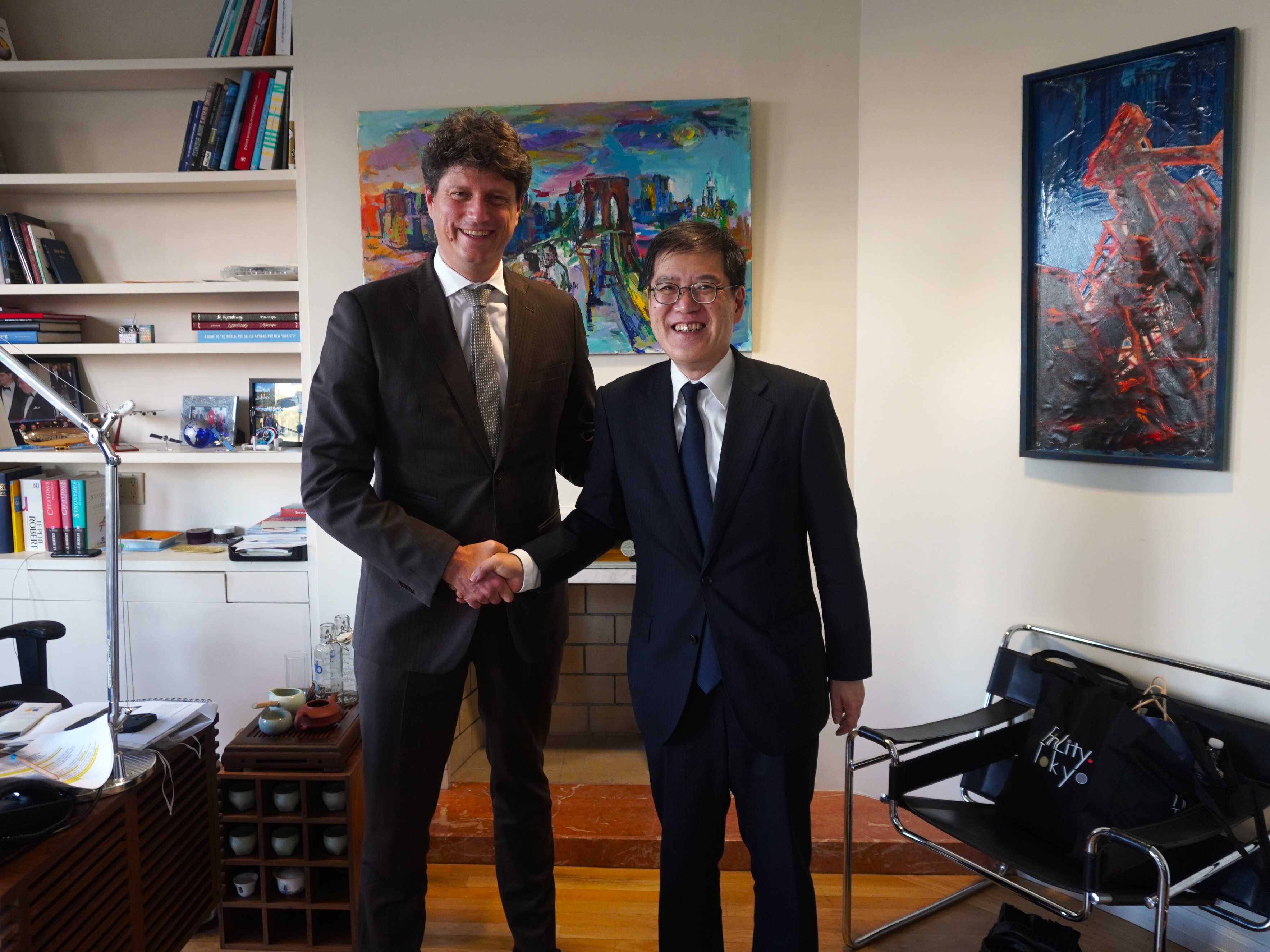
In connection with the FinCity Global Forum in New York, FinCity.Tokyo’s Executive Director Tokio Morita met with Luc Decker, Executive Director of the Luxembourg Trade and Investment Office of New York, during a reception at the Luxembourg House to discuss the significance of the Tokyo–Luxembourg relationship and how the two financial centers can develop their partnership in the years ahead.
What has the MoU achieved so far, and what opportunities could stronger Tokyo–Luxembourg ties create for market participants on both sides?
Mr. Morita:
In Japan, the government is now initiating the Asset Management Nation Initiative. For the first time in decades, the asset management industry is a focal point for government policy, and when we talk about asset management Luxembourg quickly comes to mind. There are many Japanese entities in Luxembourg relying on Luxembourgish expertise in certain fields.
Secondly, Japan is emerging as a financial hub for the green transformation. With Luxembourg of course being a leader in this field in Europe, with a high level of issuance in climate bonds and expertise in impact finance, there is much scope for us to work together.
The fact that Luxembourg House hosted a reception for representatives from the Tokyo financial center and New York financial community—on the occasion of the first-ever FinCity Global Forum in New York—serves as a symbol of the collaboration between the two sides.
Mr. Decker:
This reception marks the first time we’ve been able to organize an event outside either Tokyo or Luxembourg since the signing of the MoU, and it’s great to see the cooperation go beyond the bilateral.
Luxembourg is the largest cross-border investment fund hub in the world. It’s only natural we work together, particularly in asset management. Investors from Europe want to invest into Luxembourg and Japan, and Japanese investors like to access assets all over the world. Now, with Nippon Individual Savings Accounts (NISA), you have more and more Japanese investors who don’t want to keep cash under their beds. They can invest into regulated funds in Luxembourg to access assets all over the world. This will become even more true with tokenization and digital assets; another field we can collaborate on with Tokyo.
Why is New York an important place to begin putting the relationship into practice? How do the respective strengths of Tokyo and Luxembourg complement each other in attracting U.S. investors?
Mr. Decker:
New York is the world’s largest financial center and it’s a good place to start a partnership. In terms of Luxembourg’s cross-border investment funds, we can say the largest investors are in New York. US fund managers represent more than 20% of assets in Luxembourg funds and heavily rely on Luxembourg for international fund ranges. These Luxembourg funds are distributed in more than 80 countries and invest globally, including significantly in Japanese assets.
New York is a financial center with institutions from which we can learn much, firms with an appetite for investment into Europe and Asia.
Mr. Morita:
Japan’s current Takaichi administration has growth investment as one of its central economic pillars. Where does that money come from? Well, there are Japanese households and asset owners, and we’re trying to mobilize Japanese private sector money, of course. But we want to entice global money, and New York is the center of global investors.
Japan also wants a two-way capital flow. Japan’s Financial Services Agency (FSA) is urging the development of an alternative investment market and is encouraging the Government Pension Investment Fund (GPIF) to invest in this. The FSA is also encouraging Japanese asset managers to expand alternative investment products for retail investors. Since alternative investment isn’t Japan’s forte, Luxembourg can lend its strength there, and we hope to create a two-way capital flow between us.
Given our volatile world, how can financial centers contribute to stability and prosperity?
Mr. Morita:
There are many uncertainties in international markets today, not to mention geopolitical risks, which has led to a search for alternative markets. In this context, rule of law and political stability become very important, and Luxembourg and Tokyo are markets that are strongly characterized by these traits. By leveraging these strengths, we’d like to contribute to the stability of international markets.
Mr. Decker:
I totally agree. Especially in this volatile world, where there is a temptation of protectionism, it’s vitally important that capital be allowed to flow, and this can only happen through stable, well-regulated centers like Tokyo and Luxembourg. Financial centers can also play a very important role in diversifying investment and monitoring changes in financial markets. Right now, for instance, there is high leverage on AI and all things connected to it, which is why US investors are looking to diversify in order to not be too exposed to whatever will happen next in that field.
Mr. Morita:
I agree that the substantial investment in AI hyperscalers represents a fundamental change in the market. Also, looking medium-term, we will see growth of non-bank financial intermediaries due to tighter banking regulations. We are also seeing private credit playing a larger role in AI financing. All of these are structural changes that should be carefully monitored.
Are we seeing a shift away from bank dominance in Japan and Europe?
Mr. Morita:
As you say, Japan is a bank-dominant market, but private equity players like Apollo and KKR are very interested in expanding here. Also, many Japanese banks have started saying that in order to grow internationally, they have to expand their capital market operations, including in asset management. So, in that context, they’re closely watching Luxembourg’s market, as well as the broader European market, for opportunities.
Mr. Decker:
In Europe, there is a lot of discussion around how to activate private capital, especially pension funds. For instance, one of the main points made by the Draghi Report on the future of European competitiveness is that the flow of funds into innovation could be increased substantially. This is clearly something we need to work on.
2027 marks the 100th anniversary of diplomatic relations between Japan and Luxembourg. What would you like to see the Tokyo–Luxembourg partnership achieve?
Mr. Decker:
The Luxembourg government is definitely committed to strengthening its bonds with Japan even further. See our Osaka Expo pavilion for example; we aren’t always at world expos, but we felt it was important to be in Japan, and we will be at the Yokohama Green Expo next, which is special for us.
More to that point, when our minister of finance came to Asia, he chose Japan for his first mission. Now we have this MoU and so much more in the pipeline, and I think this partnership will only get stronger. As we will celebrate next yearone hundred years of diplomatic relations, we will be presented with renewed opportunities to bring our partnership to new levels, including in the financial sector.
Mr. Morita:
Japan is very committed to strengthening its ties with Luxembourg. Like I said, the FSA is positioning the asset management industry as comparable to banks, securities, and insurance as the fourth largest industry. In that context, this bond is very important, as is the ability to have two-way technology and expertise flow between us. FinCity.Tokyo will make the utmost of this MoU to make that happen.
We’re very grateful to be able to continue this kind of cooperation as we approach one hundred years of diplomatic relations.
Related
関連記事